


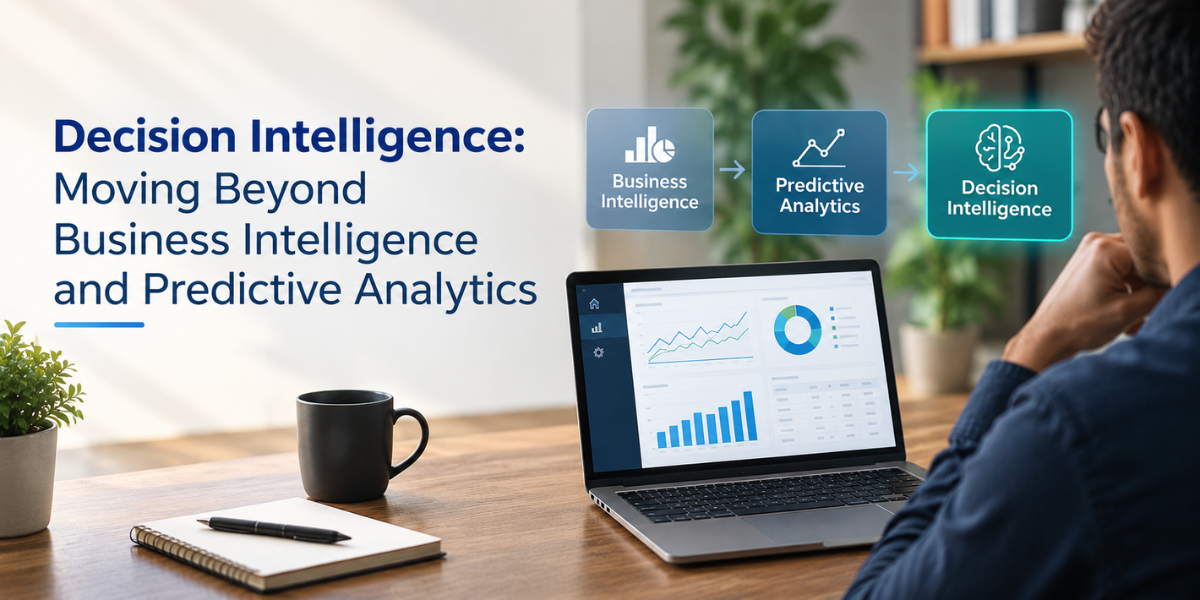
In today’s competitive business environment, making the right decision at the right time is essential for success. Businesses generate large amounts of data through sales, customer interactions, marketing activities, and daily operations. However, collecting data alone is not enough. Businesses must interpret their data effectively and apply those insights to make smarter choices. Decision Intelligence becomes essential in this situation.
Decision Intelligence combines data analytics, artificial intelligence, business knowledge, and human judgment to help organizations make informed decisions. It moves beyond traditional Business Intelligence and Predictive Analytics by focusing not only on understanding past performance or forecasting future outcomes but also on identifying the best possible actions.
What Is Business Intelligence?
Business Intelligence (BI) refers to the tools and processes used to collect, analyze, and present business data. It helps organizations understand their performance through reports, dashboards, charts, and key performance indicators.
For example, a retail business can use Business Intelligence to identify its best-selling products, compare monthly sales, and understand customer purchasing patterns. These insights help managers evaluate performance and identify areas that need improvement.
However, Business Intelligence mainly focuses on understanding what has happened and why it happened. Although this information is valuable, businesses often need additional insights to determine their next steps.
Understanding Predictive Analytics
Predictive Analytics examines past data using statistical methods and machine learning to forecast potential future results. It helps businesses identify possible trends, anticipate customer needs, and prepare for potential risks.
For example, an educational institution can analyze previous admission data to estimate future student enrolments. Similarly, an e-commerce company can predict product demand and plan its inventory accordingly.
Predictive Analytics enables businesses to anticipate possible future trends and outcomes. However, predictions do not automatically tell decision-makers which action they should take. Businesses must still evaluate different options, resources, and potential outcomes before making a final decision.
What Makes Decision Intelligence Different?
Decision Intelligence takes business analytics a step further by connecting insights with practical actions. It combines data, analytical models, business objectives, and human expertise to evaluate different decisions and their possible consequences.
Instead of simply asking what happened or what might happen, Decision Intelligence focuses on what action should be taken and why.
For example, if a company predicts a decline in sales, Business Intelligence can reveal the sales trend, while Predictive Analytics can estimate how much sales might decrease. Decision Intelligence can help compare possible responses, such as adjusting prices, improving marketing campaigns, or introducing new offers.
This approach enables organizations to make decisions that align with their goals, available resources, and changing market conditions.
Key Benefits of Decision Intelligence
1. Better Decision-Making
Decision Intelligence helps managers assess alternatives using data and business goals, allowing them to make informed choices rather than depend on assumptions.
2. Improved Operational Efficiency
By identifying effective actions and potential bottlenecks, businesses can allocate resources more efficiently, streamline workflows, and reduce unnecessary costs.
3. Faster Business Responses
Markets and customer expectations change quickly. Decision Intelligence helps organizations assess new information and respond to changing conditions with greater confidence.
4. Enhanced Customer Experience
Businesses can use customer behaviour, preferences, and feedback to make informed decisions about products, services, pricing, and communication strategies.
5. Better Risk Management
By evaluating possible outcomes and considering different scenarios, organizations can identify risks earlier and prepare suitable responses.
How Artificial Intelligence Supports Decision Intelligence
Artificial Intelligence (AI) plays an important role in Decision Intelligence by processing large datasets, identifying patterns, generating predictions, and evaluating possible scenarios. Machine learning models can improve analytical capabilities as new information becomes available.
However, technology alone cannot guarantee effective decisions. Human judgment remains important for understanding business priorities, ethical considerations, customer needs, and real-world limitations. Combining AI capabilities with human expertise creates a more balanced approach to decision-making.
Why Decision Intelligence Matters for Future Managers
Modern managers need a broader skill set than traditional business knowledge alone can provide. They must understand data, interpret analytical findings, evaluate alternatives, and translate insights into practical business strategies.
Studying Business Intelligence, Predictive Analytics, AI, and Decision Intelligence helps students build the analytical and strategic skills needed in modern workplaces. Management education can introduce these concepts through practical projects, business case studies, and real-world problem-solving activities.
As businesses increasingly adopt data-driven strategies, professionals who can connect analytical insights with effective decisions will be better prepared to address complex business challenges.
Conclusion
Decision Intelligence represents an important development in modern business management by moving beyond traditional Business Intelligence and Predictive Analytics. It connects data, technology, and human judgment to help organizations choose effective actions, manage risks, and achieve their objectives Knowledge of these methods is becoming increasingly important for future managers and business professionals.
For students exploring Management Education in Hubli, understanding emerging business technologies and analytical methods can provide useful preparation for a changing professional environment. IEMS B-School can be a starting point for exploring management education and the skills needed to understand modern business challenges. As organizations continue to embrace data-driven strategies, Decision Intelligence in Business will remain an important approach to making informed, responsible, and forward-looking decisions.