

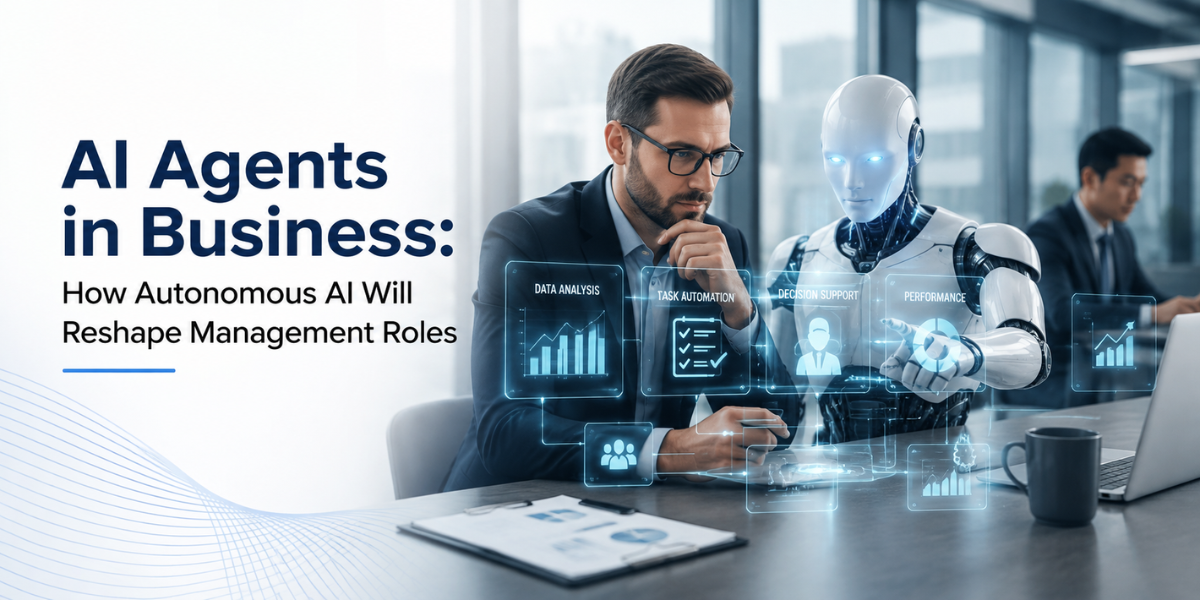
Artificial intelligence is moving beyond simple chatbots and automated tools. The next major shift is the rise of AI agents: systems that can understand goals, make decisions, perform tasks, and adapt based on results with limited human intervention. As businesses adopt these autonomous systems, management roles are likely to change significantly.
For future business leaders, understanding AI agents is no longer optional. It is becoming an important part of learning how organizations will operate, compete, and grow.
What Are AI Agents?
AI agents are intelligent software systems designed to complete tasks or achieve specific objectives. Unlike traditional software that follows fixed instructions, AI agents can analyze information, plan actions, use digital tools, and respond to changing situations.
For example, an AI agent in sales could identify potential customers, analyze their requirements, prepare personalized communication, update a CRM, and schedule follow-ups. A management team could then focus more on strategy and relationship building rather than repetitive administrative work.
How AI Agents Will Change Management
The impact of autonomous AI will not simply be about replacing jobs. In many cases, it will change what managers spend their time doing.
1. Less Administrative Work
Managers often spend considerable time preparing reports, analyzing spreadsheets, scheduling meetings, tracking performance, and handling routine communication. AI agents can manage many of these routine tasks, helping reduce the workload for managers.
This allows managers to spend more time on decision-making, employee development, innovation, and business strategy.
2. Faster Decision-Making
AI agents can process large amounts of business data quickly. They can identify trends, detect unusual changes, compare possible outcomes, and provide recommendations.
For managers, this means decisions can increasingly be supported by real-time information instead of relying only on periodic reports or intuition.
3. Managers Will Become AI Orchestrators
Future managers may not simply manage people. They may also manage AI agent teams.
A marketing manager, for example, could assign different AavaI agents to research customers, analyze competitors, generate campaign ideas, monitor advertising performance, and prepare reports.
The manager’s role would be to define objectives, review results, make critical judgments, and ensure that AI-driven activities support the organization’s goals.
4. Human Skills Will Become More Valuable
As AI handles more routine analytical and operational tasks, uniquely human abilities will become increasingly important.
Leadership, communication, emotional intelligence, negotiation, creativity, ethical judgment, and relationship management will remain essential. Managers will need to understand when to trust AI recommendations and when human judgment should take priority.
New Challenges for Business Leaders
The adoption of autonomous AI also creates challenges. Managers must consider data privacy, cybersecurity, inaccurate AI outputs, bias, accountability, and ethical decision-making.
An AI agent may make a recommendation based on incomplete or incorrect information. Therefore, businesses need clear policies, human oversight, and appropriate controls.
Managers will also need to help employees adapt to changing responsibilities. Instead of simply introducing AI tools, organizations must invest in training and create a culture where employees understand how to work effectively alongside intelligent systems.
Preparing Future Managers for an AI-Driven Business World
Business education will play an important role in preparing students for this transformation. Future managers need more than traditional knowledge of finance, marketing, human resources, and operations. They also need an understanding of AI, data, automation, digital strategy, and technology-driven business models.
Students should develop the ability to evaluate AI tools, identify business opportunities, understand their limitations, and use them responsibly. Practical exposure to emerging technologies can help aspiring managers become more confident in making technology-based business decisions.
Institutions such as IEMS B-SCHOOL can help students develop this combination of management knowledge and digital awareness, preparing them for workplaces where humans and AI systems increasingly collaborate.
Conclusion
AI agents are likely to reshape management by automating routine work, accelerating decisions, and creating new ways for organizations to operate. The future manager will increasingly act as a strategist, leader, problem-solver, and orchestrator of both human and AI capabilities.
For students planning a career in management, learning how autonomous AI works can provide a valuable advantage. Choosing the right Management college in Hubli and pursuing an MBA in Hubli can help students build the business knowledge and adaptability needed for an AI-driven future. IEMS B-SCHOOL can be a strong environment for students who want to understand modern management while preparing for the changing demands of business.